There’s a lot of death in The Wild Robot, and a lot of it is a joke. The early introduction of a mother possum (voiced wonderfully by Catherine O’Hara) and her most recent litter set the tone when she refers to herself as “a mother of seven” before we hear a snarl followed by a yelp off screen and she corrects herself to “mother of six.” Later, one of that litter tells the titular robot, Roz (Lupita Nyong’o), “death’s proximity makes life burn all the brighter.”
The film uses that callousness and absurdism to genuinely acknowledge the horrors of existence for animals who live in a predatory food chain (another early scene literally shows a bird torn to pieces by a big cat). In doing so, The Wild Robot lets the audience more fully connect with the central cast of Roz, her adopted runt gosling Brightbill (Boone Storm, then Kit Connor), and fox Fink (Pedro Pascal). It’s the same trick Bojack Horseman and Rick and Morty perfected almost a decade ago: engaging an honest cynicism allows for a more honest sincerity. But The Wild Robot isn’t a TV-MA-rated piece of serialized adult animation, it’s a PG-rated DreamWorks Animation movie based on a book aimed at kids and tweens.
The story about outcasts coming together, learning from one another, ultimately inspiring others to accept differences and work together despite them reflects that young audience and is nothing new. Yet the life and death stakes of the movie make every one of the arguably rote narrative beats land emotionally; as does the fantastic character animation, and the talented voice cast.
Nyong’o, Connor, and Bill Nighy as an elder goose all deftly maneuver between the film’s often flippant comedy style and its sometimes overbearing statements about the power of love with voice performances that would be Oscar-worthy if Oscars existed for voice performances. Nighy in particular is saddled with lines that are laughable on the page but lends them an emotional truth that’s impossible to snark at. Pascal sells Fink’s emotional lines while struggling with the comedy, leaving the fox sometimes feeling like an unnecessary addition to the surrogate mother and son pair of Roz and Brightbill.
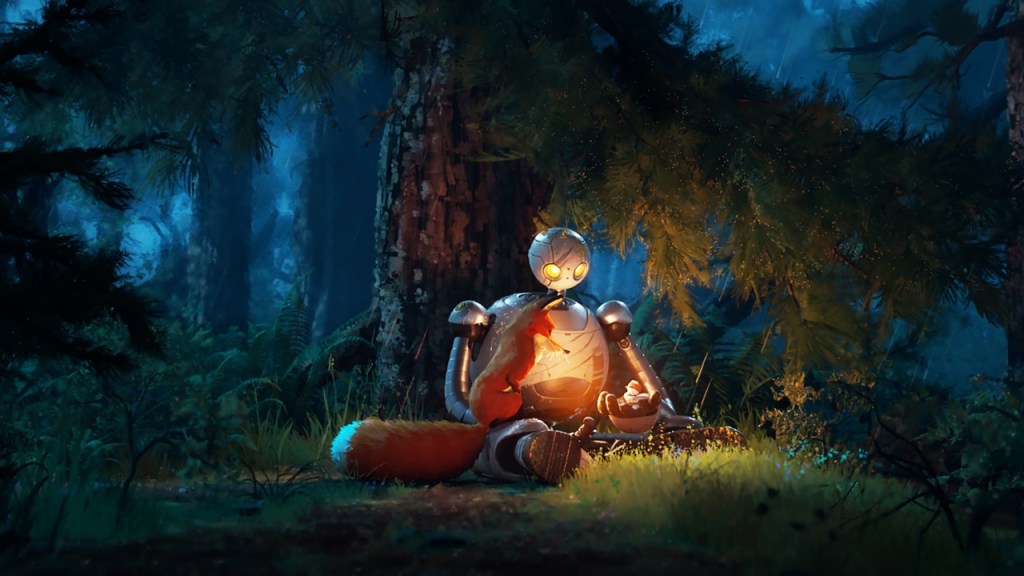
The actors aren’t on their own in communicating the inner worlds of these characters though. Writer/director Chris Sanders and his team of animators deliver remarkable physical performances from their anthropomorphized animal characters and Roz, whose face is a sphere with two large glowing circles for eyes and two small circles that approximate a nose. There’s a real depth of feeling in movements as simple as the slow bowing of a head from Roz that makes her feel as expressive as the animals whose eyes communicate so much you almost forget they’re drawings.
The detail of the animals’ faces contrasts starkly with the impressionistic world of the movie they inhabit. Sanders sought to make the final film look as loose as the early exploratory art and the result is stunning. We can see that sense of looseness and a commitment to paint in every frame of the film. Whether it’s gray rocks that look rough to the touch because of the overlapping brush strokes, or the trees so abstractly brought to life that their leaves are unshaped dabs of greens and yellows.
Within this already awe-inspiring world, light and water are especially marvelous. The often diffuse sunlight sparkles on the calm ponds and lakes of the island, while rivers and the surrounding ocean roar with chaotic white foam rendered in frantic splashes of paint. In nighttime scenes, Roz regularly turns her eyes into far-reaching searchlights that cut through the darkness with a bright yellow that casts even darker shadows. Patterned grooves along Roz’s body emit different colors at different times, offering a nice contrast with her initially white, increasingly gray exterior. These grooves are especially striking in a blizzard scene where the colored light pollution interacts with the bits of snow buffeting Roz creating a sort of lightshow.
The explosions that burst with the purples and blues of sci-fi energy beams during action scenes late in the movie match the beauty of Roz’s battle with the elements, but they’re a product of unnecessary developments. The movie reaches a moving climax around its halfway point and miraculously maintains its emotional intensity through the entire back half. But the developments that keep things going introduce far more concrete villains than the difficulty of surviving in the wild, thereby betraying the stakes and profundity established earlier in the film.
The simplification of its initially complex moral universe and Pascal’s not quite up to snuff vocal performance keep The Wild Robot from being perfect, but it’s close.
 Allergic to the 21st Century
Leave a comment