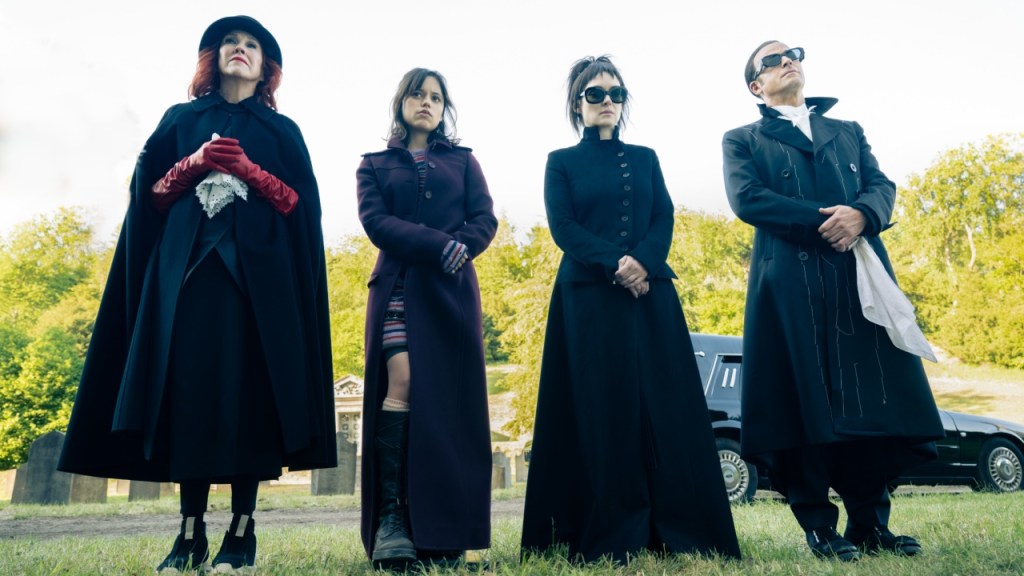
Tim Burton’s 21st century output has been spotty at best and while legacy sequels may have a slightly better hit rate than he does at the moment, they’re also starting to feel more and more like pure cash grabs. So, despite Beetlejuice’s position as my favorite Burton film, I only ever expected Beetlejuice Beetlejuice to be a trainwreck.
Imagine my surprise that it mostly works. Mostly.
It’s unclear how many different scripts and story ideas the film brings together as various Beetlejuice sequels have been in the works since the early 90s. But it seems impossible that what became Beetlejuice Beetlejuice was conceived as a single cohesive story. The film includes so many plotlines that some are dropped for what feels like half the film before being rushed back in for the finale.
There’s Beetlejuice’s (Michael Keaton) literally soul-sucking ex-wife Delores (Monica Bellucci) hunting him down and leaving a trail of double dead characters in her wake. Willem Dafoe is having maybe the most fun an actor has ever had on screen as an actor who played a cop in movies during his life and now plays a cop in the afterlife. The Deetz family plot feels like a more emotionally honest version of the “three generations of women” thing David Gordon Green’s Halloween movies were going for. Lydia (Winona Ryder) has become the uncool mom she rebelled against as a teen, and now seeks support from that uncool (step)mom Delia (the inimitable Catherine O’Hara) with how to deal with her resentful daughter Astrid (Jenna Ortega). And then, just for good measure, both Lydia and Astrid have romance plots.
Albeit, Lydia’s “romance” is less romantic and more exasperating as she struggles to maintain any level of interest in her only-communicating-in-therapy-speak boyfriend/business manager Rory (Justin Theroux) as he attempts to weasel his way into her family. Theroux’s performance, like many others in the film, is dialed all the way up and makes most of Rory’s bullshit funny, but sometimes it’s hard not to get exasperated along with Lydia.
That’s sort of how the entire film feels. Its many plots are overwhelming and almost exhausting to hold onto, yet the game cast and Burton’s palpable joy to be playing in this world again make it largely succeed. Every line delivery from O’Hara is hilarious, often more for her delivery than the line itself. The practical effects that conjure the afterlife and its denizens are clear labors of love that are a delight to look at and allow the film to draw on nostalgia for the first film without stooping to awkwardly repeating lines from the original. Burton and cinematographer Haris Zambarloukos create some remarkable images, especially early on in a gallery space that combines screens, sculptures, mirrors, and murals.
Even the blatant avoidance of allowing Jeffrey Jones to return as Lydia’s father/Delia’s husband Charles is used as an opportunity for more visual fun. A claymation sequence shows the story of how Charles died in a plane crash, and every time we see him in the afterlife, he’s missing most of the top half of his body and speaks through a severed esophagus.
An afterlife “Soul Train” pun that fills a train station with mostly Black disco dancers late in the movie is clearly on the same wavelength of fun for Burton, but it’s uncomfortable as a viewer. There are no Black characters in the movie besides these dancers. And more than that, filling the screen with Black people for two minutes of this otherwise almost entirely white movie feels like a childish response to the criticism that there aren’t any Black (or any color other than white) people in his films; a sort of “you want Black people in my movies, fine, here you go.” The joke isn’t offensive in itself, it just contrasts so starkly with the movie that surrounds it and exists in far too much context to be easily waved away.
It’s a gag that marks the movie as Burton in a bad way as well as Burton in a good way. Pulling down his best film in years into something more deeply flawed than a mostly wonderful movie with too many stories battling for screen time.
 Allergic to the 21st Century
Leave a comment